
The Flood Insurance Gap Is Growing, and Florida Homeowners Are Being Left to Cover the Difference
Your street floods. Your home is unlivable. You go looking for help, and there is no insurance check coming and no clear plan for repairs. For a growing nu

7/13/2026 | 1 min read
Flood Claim Denied or Underpaid? Check Your Options
Flood claims require fast action. Take our 2-minute qualifier — free, no obligation.
See If You Qualify — Free Eligibility Check →No fees unless we win · Takes under 2 minutes · No obligation
The Flood Insurance Gap Is Growing, and Florida Homeowners Are Being Left to Cover the Difference
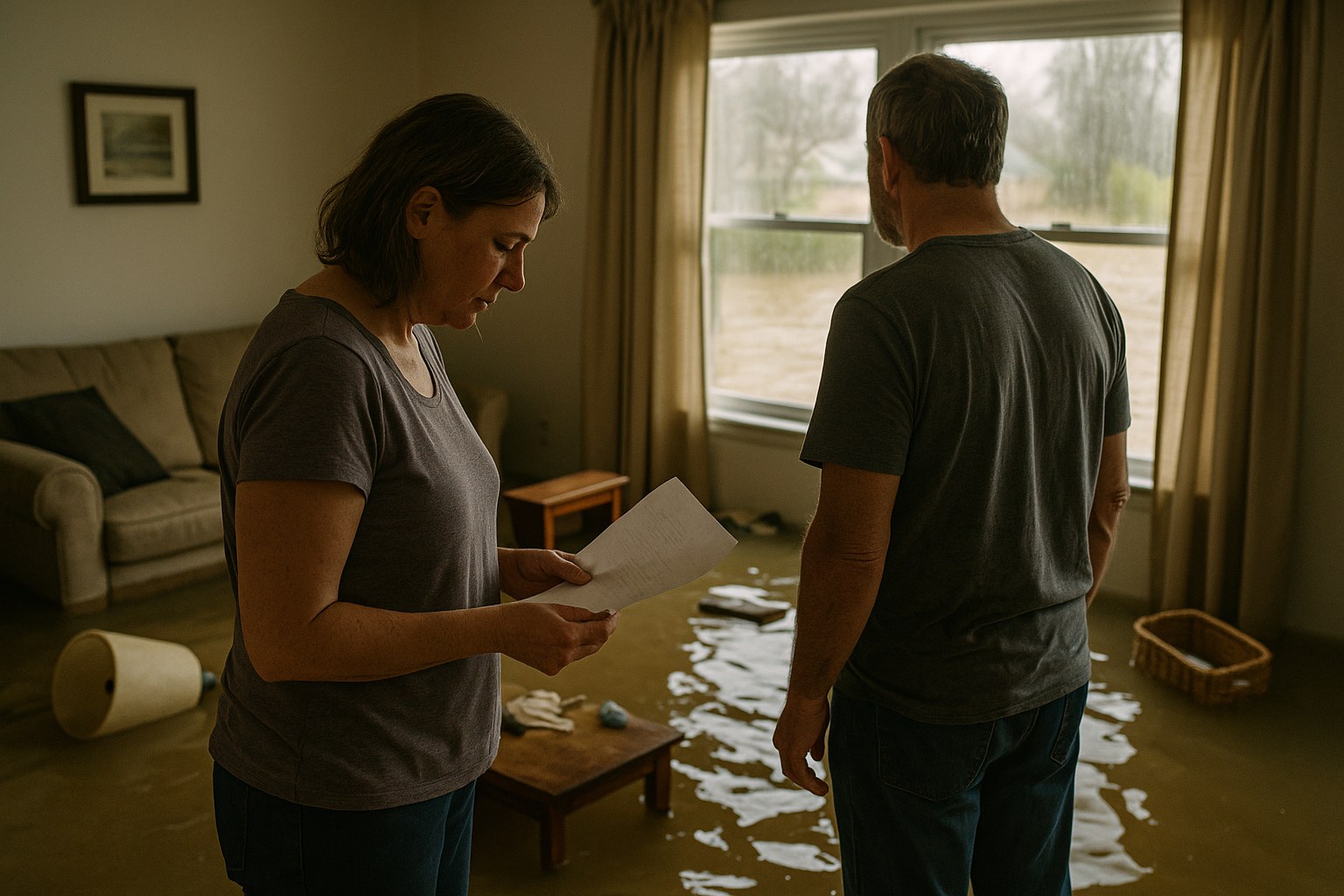
Your street floods. Your home is unlivable. You go looking for help, and there is no insurance check coming and no clear plan for repairs. For a growing number of Florida property owners, that is not a hypothetical. A recent analysis from Moody's Ratings says the gap between flood risk and flood insurance is widening across the country, and the cost is quietly shifting onto homeowners and onto the state and local governments that are supposed to backstop them.
Florida sits at the center of that shift. If you own a home here, the mechanics of what happens after the next major storm are changing, and it is worth understanding what that means for your coverage and your rights before you need them.
Why this matters to you in Florida
Federal disaster aid is under discussion for cutbacks, and Moody's analysts noted that Florida, Texas, Louisiana, and North Carolina received the largest share of federal disaster aid relative to state revenue from 2017 through 2025, according to reporting by Insurance Journal. Louisiana alone drew more than 5% of its revenue from that aid, per the same report. The states that have leaned hardest on federal disaster money are also the ones most exposed if that money shrinks. Florida is on that list.
At the same time, Florida lawmakers this year moved to cut much of the state's property taxes for homeowners. If voters approve the change, it could cost local governments as much as $12 billion a year, according to economists cited in the Insurance Journal report. Less local revenue means less capacity for the very governments that Moody's says are already absorbing flood costs insurance used to cover.
Put those pieces together and the picture for a Florida homeowner gets clearer. Fewer flood policies in force, a shakier federal backup, and thinner local budgets all point the same direction: after a flood, more of the burden is likely to land on you. That makes the flood coverage you do carry, and your ability to enforce it when a claim goes sideways, more important than it was five years ago.
What the Moody's analysis actually found
Analysts at Moody's Ratings, the global credit rating and analytics firm, laid out the problem in a recent webinar covered by Insurance Journal. Firas Saleh, Moody's director of insurance solutions and product management, described insurance as a "shock absorber" for flood losses. When that absorber is missing, the costs do not vanish. They land on households without adequate coverage, on federal assistance programs, and increasingly on state and local governments that end up paying for debris removal, demolished structures, road repairs, and temporary housing, according to the same report.
The participation numbers behind that shift are stark. Roughly 470,000 National Flood Insurance Program policies were dropped between 2018 and early 2026, and 5.6 million policies have left the program since 2009, Moody's analysts said, as reported by Insurance Journal. Private flood insurers picked up some of that business, but the overall level of U.S. flood coverage stayed roughly flat. The gap itself has not closed.
The effects are already visible in local government finances elsewhere. After Hurricane Harvey in 2017, several coastal Texas counties faced budget deficits once flooded properties were reassessed and tax revenue fell, Moody's vice president Denise Rappamund said. Buncombe County, North Carolina, hit hard by Hurricane Helene flooding in 2024, saw its credit outlook temporarily downgraded to "negative," according to Moody's vice president Jennifer Chang, as reported in the same article.
Moody's also reported that FEMA's official flood maps likely understate the true footprint of flood risk. Using Houston as an example, Moody's own modeling showed a 1-in-100-year flood covering far more square miles than FEMA's maps depict, per the same reporting. For Florida readers, that is the detail worth sitting with. Being outside a mapped high-risk flood zone is not the same as being outside the actual risk, and it does not mean a flood policy is unnecessary.
What Florida homeowners should know about flood coverage
Start with the most common and most expensive misunderstanding: a standard Florida homeowners policy generally does not cover flood damage. Flood coverage typically has to be purchased separately, either through the National Flood Insurance Program or through a private flood insurer. Homeowners who assume their existing policy handles rising water often find out otherwise only after the water recedes.
A few practical points follow from that:
Check whether you actually have flood coverage, not whether you think you do. Pull the declarations page. Flood is a separate policy or a separate endorsement, and it will say so.
Do not treat a FEMA map as a risk verdict. Moody's modeling suggests those maps can understate the real flood footprint. Lenders may not require flood insurance outside a mapped zone, but the water does not check the map.
Document everything from day one. Photos and video before and after, repair estimates, receipts for temporary housing, and every piece of correspondence with your insurer. Documentation is often what separates a claim that gets paid from one that stalls.
Know that Florida law sets deadlines and procedures. Florida insurance law imposes timelines and obligations on how insurers must acknowledge, investigate, and respond to claims, and it sets deadlines that apply to policyholders as well. Missing a deadline can limit options that were otherwise available, so it is worth confirming the timelines that apply to your specific policy early rather than late.
If a flood claim is delayed, underpaid, or denied, Florida policyholders may have avenues to challenge that decision. Whether any particular avenue applies depends heavily on the specific policy language, the type of policy, and the facts of the loss. NFIP claims and private flood policies can follow different procedures, which is one reason a close read of your own policy matters.
The larger point for policyholders
Insurance exists so that catastrophic, unpredictable losses get spread across a large pool instead of crushing one household at a time. What the Moody's analysis describes is a system that, for flood risk, is not fully doing that job. Millions of policies have left the NFIP, private insurers have not closed the gap, and the maps people rely on to decide whether they need coverage appear to undersell the actual risk, according to the reporting cited above.
Nothing in that reporting says any individual insurer or regulator set out to produce this result, and we are not suggesting otherwise. What the analysis does show is a widening distance between flood risk and flood coverage, with homeowners, local governments, and taxpayers absorbing more of the difference.
For Floridians who pay flood premiums year after year, the takeaway is not that the system is stacked against you and there is nothing to do about it. It is the opposite. Coverage you have paid for is a contract, and when a covered claim is delayed, underpaid, or denied, that contract comes with rights attached. Knowing what your policy actually covers, keeping records that prove your loss, and getting a clear read on your options when an insurer says no are the parts of this that remain within your control.
This article is general information, not legal advice, and does not create an attorney-client relationship. Insurance policies, flood zone determinations, and claims outcomes vary by individual circumstances, and readers should consult a licensed attorney about their specific situation.
If you are dealing with a denied, delayed, or underpaid flood insurance claim in Florida, a consultation with Louis Law Group may help clarify what options could be available to you under your policy and Florida law.
Sources
Is your insurance company handling your claim fairly?
Answer 5 questions. We'll analyze your claim against Florida property insurance law and show you exactly where you stand.
General information only, not legal advice. Based on Florida insurance law and claim best practices.
Get Your Free Property Damage Checklist
24-step claim guide — protect your rights after damage to your home
Free. No spam. Unsubscribe anytime.
Flood Claim? Find Out If You Qualify — Free Case Review
No fees unless we win · 100% confidential · Same-day response
★★★★★ 4.7 · 67 Google Reviews
What Our Clients Say
Real reviews from real clients who fought their insurance companies — and won.
"Citizens denied our roof leak claim, but this firm fought for us and got money for our repairs. We even had funds left over after fixing the roof."
"Pierre and his team are amazing. They truly cater to their clients and help you get the most from your insurance company."
"When my insurance company denied my roof damage claim, Louis Law Group stepped in and fought for me. I'm extremely satisfied with the results they obtained."
"They accomplished exactly what they set out to do and helped me finally receive my insurance check."
"Louis Law Group handled our homeowners insurance dispute and got results much faster than we expected. Excellent service and great communication."
"Very professional attorneys with outstanding attention to detail. They will not stop fighting for their clients."
* Reviews from Google. Results may vary by case.
How it Works
No Win, No Fee
We like to simplify our intake process. From submitting your claim to finalizing your case, our streamlined approach ensures a hassle-free experience. Our legal team is dedicated to making this process as efficient and straightforward as possible.
You can expect transparent communication, prompt updates, and a commitment to achieving the best possible outcome for your case.
Free Case EvaluationLet's get in touch
We like to simplify our intake process. From submitting your claim to finalizing your case, our streamlined approach ensures a hassle-free experience. Our legal team is dedicated to making this process as efficient and straightforward as possible.
12 S.E. 7th Street, Suite 805, Fort Lauderdale, FL 33301